The God of the Qur’ān challenged humanity with the words: Will they not then ponder on the Qur'an? If it had been from other than Allah they would have found therein much incongruity [Qur’ān IV, 82]. We might well be surprised that a God of unlimited power, the Creator of the universe and all that is in it, would seek to challenge weak humankind who were created by Him.
NONETHELESS, given the permission thus granted to reflect upon and examine the Qur’ān, we will accept the challenge and ponder on its chapters and verses. We will see what it contains, and it is our right by virtue of the authority the Qur’ān has granted us, to question whether it indeed contains errors. Should this be so, we may conclude that the Qur’ān is a book authored by humans and not coming from God.
We will make the assumption first and foremost that the Qur’ān is a divinely inspired book, entirely the word of God sent to His Prophet Muḥammad through His angel Gabriel, to convey it to humanity and guide them to the worship and oneness of God, the Creator of the universe, of life and of all humankind.
It is understood in Islam that every chapter and verse in the Qur’ān is presumed to have been uttered by God, with the exception of the sayings of the jinn, the angels, earlier prophets, the Messiah, some ancient poets and the Prophet’s companions. It is also understood that Muḥammad himself did not personally participate in the authorship of any chapter or verse of the Qur’ān.
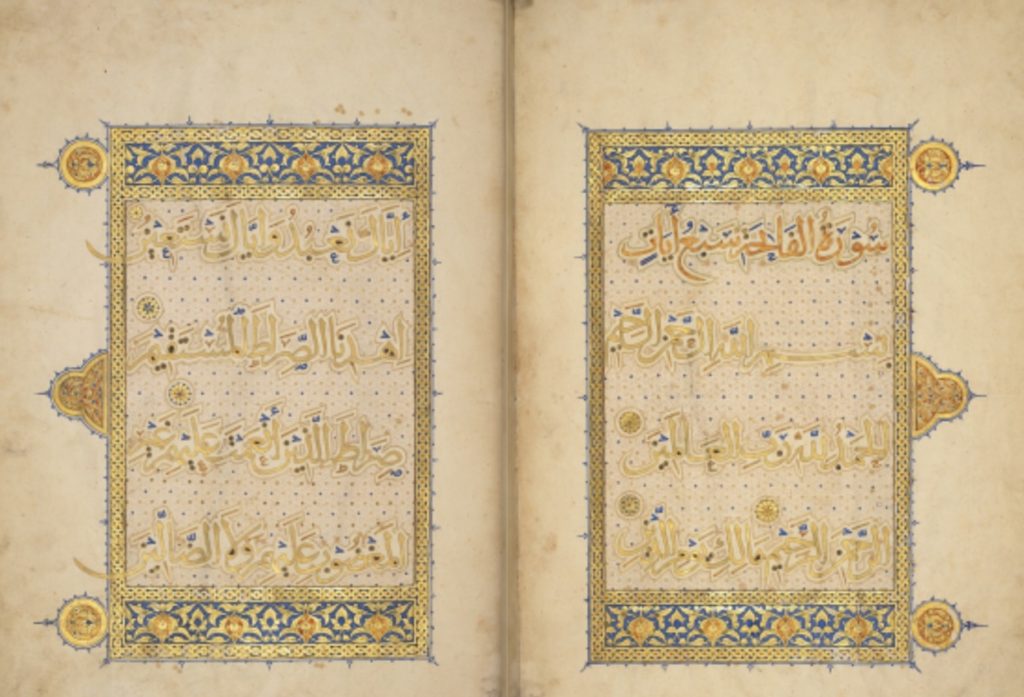
The Opening Sūrat al-Fātiḥa
In the name of Allah, the Most Gracious, the Most Merciful. All praise is due to Allah, Lord of the worlds. The Most Gracious, the Most Merciful. Master of the Day of Judgment. You alone we worship, and You alone we ask for help. Guide us to the straight path. The path of those upon whom You have bestowed favour, not of those who have evoked [Your] anger or of those who go astray.
God here addresses Himself and praises Himself saying: All praise is due to Allah, Lord of the worlds. God is thus worshiping Himself and seeking help from Himself by saying: You alone we worship, and You alone we ask for help. He then asks for guidance for Himself ‘to the straight path’. God then goes on to criticize some of His servants, describing them as those who have incurred His wrath and those who have gone astray.
Muslims may object to our criticism, saying that this sūra was revealed by God to mankind to serve as a supplication to recite to their Lord, as an opener to their prayers. But what is the evidence that God said to Muḥammad or to mankind: ‘Recite this?’ Did He begin it with the word ‘Say’ like the other sūras and verses that begin with ‘Say’ or ‘O mankind’? The answer to this is no. Therefore, it must be considered to be God’s own words, all of which demonstrate clear errors concerning God. The truth is that it this has been composed by the author of the Qur’ān.
We might therefore wonder why the God of the Qur’ān was incapable of revealing a single version which Muslims would not disagree on
Can God say to Himself: You alone we worship, and You alone we ask for help? If it were the words of God to the people, it would run as follows: You alone we worship, and in You we ask for help, not You alone we ask for help.
More than one and a half billion Muslims repeat the Sūrat al-Fātiḥa several times daily without taking note of these errors. These errors have been programmed into their minds, and none dares to raise an objection or ask for a correction.
Muslims and commentators invent convoluted linguistic methods to evade and explain such errors in a way that will convince ordinary people, without venturing to admit the error or correct it.
The Seven Readings of the Qur’ān
The multiplicity of Qur’ānic readings caused variations in the writing of several different copies of the Qur’ān. Al-Sijistānī listed 26 copies that were in exitence following the death of Muḥammad. The most famous of these were the copy of Ḥafṣa, the copy of Ubayy ibn Ka‘b, the copy of Ibn Mas‘ūd, the copy of Zayd, and others.
The reason for the existence of these multiple readings of the Qur’ān goes back to the Prophet of Islam himself. He would recite some verses to his followers in one way, then later recite them to others in a different way, adding or changing some words because he had forgotten the original version. He would then delete, add or modify the verse, and the listeners would duly memorize it according to the way they heard it from the Prophet. They later differed in their readings, each claiming to have heard it from the Prophet in a particular way. After they consulted the Prophet on this, he declared that all the readings were correct because they had been ‘revealed in seven different readings’. Thus, he resolved the differences that had arisen from his own forgetfulness and variations in how he recited them
These differences in the Qur’ānic readings, which were later written down in the copies of the Qur’ān along with errors, became a cause of armed conflict among Muslims. To resolve these problems and call a halt to the fighting and division, the Caliph ‘Uthmān ibn ‘Affān collated the versions of the Qur’ān into one single reading and burned the remaining copies.
The process of collating the Qur’ān and burning the Companions’ copies of the Qur’ān was one of the reasons for which Caliph ‘Uthmān ibn ‘Affān paid with his life. The Muslims disembowelled him and slew him while he was in his house reading the Qur’ān. The sources discussed the different readings and variations in the Qur’ānic manuscripts. Ibn al-Nadim listed eleven works on this subject, including:
In addition, there are three books all of them with the title Al-Maṣāḥif by Ibn Abī Dāwūd al-Sijistānī (d. 316 AH/928 CE).
The Encyclopedia of Islam (Vol. 26, p.8180) adds further manuscript variations, and another source states that:
There are other variant readings attributed to a number of second-generation Muslims such as al-Aswad ibn Yazīd, ‘Alqama, Qaḥṭān and others.
It also states that:
More variants were attributed to other secondary manuscripts, and these were more numerous than the variants attributed to the primary manuscripts.
And in addition to three manuscripts written by ‘Abdullah ibn Mas‘ūd, Ubayy ibn Ka‘b and Abū Mūsā ‘Abdullah al-Ash‘arī, there are manuscripts attributed to twelve Companions: the second Caliph ‘Umar ibn al-Khaṭṭāb, the fourth Caliph ‘Alī ibn Abī Ṭālib, three attributed to the Prophet’s wives – Ḥafṣa bint ‘Umar, ‘Ā’isha bint Abī Bakr, Umm Salama – and four that differ: the Madinans Zayd ibn Thābit, ‘Abdullah ibn ‘Abbās, Anas ibn Mālik and ‘Abdullah ibn al-Zubayr.
Suggested Reading
Traces of multiple readings in manuscripts are still present today. The official manuscript adopted in Saudi Arabia and Egypt, for example, is based on the Ḥafṣ recitation from ‘Āṣim, which does not perfectly match the version of. Warsh from Nāfi‘.. There are differences in writing style, deletions, and additions of new words.
We might therefore wonder why the God of the Qur’ān was incapable of revealing a single version which Muslims would not disagree on. These differences in the Qur’ānic text raise several fundamental questions in our minds: how can these differences occur in the Qur’ān when its Lord says:
Surely We have revealed the Reminder and We will most surely be its guardian. [Qur’ān XV, 9]
God criticizes what He Himself created
In a strange verse in the Qur’ān we find that God criticizes what He Himself created and disapproves of the voice of one of His creatures. In sūrat Luqmān verse 19, it states:
Be modest in thy bearing and subdue thy voice; surely the most hateful of voices is braying of the asses.
Is this also the word of God, the One who created the donkey, who then disapproves of the voice He chose for it?
God’s challenge to people in the Qur’ān
God says in the Qur’ān:
O mankind! worship your Lord, Who hath created you and those before you, so that ye may ward off (evil)… And if you are in doubt as to that which We have revealed to Our servant, then produce a chapter like it. [Qur’ān II, 21, 23]
Here the God of the Qur’ān challenges His weak servants to produce something to match what He has revealed, despite the many errors it contains! Does a Creator lay down a challenge to His own creation?
The Qur’ān is a book in classical Arabic. Does this God then challenge Pakistani, Indian, Chinese and Russian Muslims to produce something the like of what He revealed in the Arabic language? Does this God not know that the inhabitants of the world are of different races and speaking languages that are different from the Arabic language, and that these neither understand the language of the Qur’ān nor have heard of it?
Addressing his Prophet God speaks in the third person. Can God say, addressing His Prophet,
There is no God but He …He is the One who revealed the Book to you… He is the One who created you from clay, then decreed a term, a term appointed with Him…. He it is Who made the sun a shining brightness and the moon a light, and ordained for it mansions?[1]
Can God say in His Book:
And your God is one God. There is no God but He, the Most Gracious, the Most Merciful? [2]
Why does He not say, “There is no god but Me”?
“If it were from other than God, you would have found in it much incongruity”. We have indeed found many incongruities in it. Is it therefore the word of God or the composition of Muḥammad and his Companions?
[1] Qur’ān III,7; VI,2; X,5;
[2] Qur’ān II,163.