Research studies are demonstrating that there were a large number of religious groupings in the first centuries, and that these groups formed a veritable mosaic of Christian Jews, Nazarenes, Nazarene Jews, Christianised Jews and that Muḥammad is not presented as an emissary of a call to a new faith. The idea of the superiority of Muslims over non-Muslims may thus have been a post-Muḥammad invention developed during the Abbasid era under ‘Abd al-Malik ibn Marwān.
BY JADOU JIBRIL
RESEARCHERS have come to conclude that there was a purely Jewish-Christian alliance that was very close to the alliance of the Ebionite[1] or Elkesaite[2] communities. ‘Muḥammad’ may have been employed by the panel of commentators to proclaim in an immortal way the ‘revelation’ of the true Covenant of the caliphs, rather than the ‘revelation’ of the Word, which men rejected as they rebelled against the alliance.
Sūrat al-Mā’ida, verse 48:
And We have revealed to you the Book with the truth, verifying what is before it of the Book and a guardian over it, therefore judge between them by what Allah has revealed, and do not follow their low desires (to turn away) from the truth that has come to you; for every one of you did We appoint a law and a way, and if Allah had pleased He would have made you (all) a single people, but that He might try you in what He gave you, therefore strive with one another to hasten to virtuous deeds; to Allah is your return, of all (of you), so He will let you know that in which you differed.
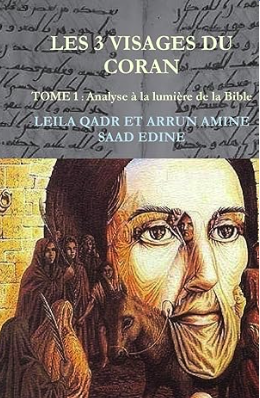
In an interview with Leila Qadr for her book The Three Faces of the Qur’ān, published by Paris Press in 2014 and co-written with Arūn Amīn Sa‘d al-Dīn, the latest historical, archaeological and Biblical research was discussed that elucidated the composition of the Qur’ān. In a gradual process of formation, the Book collected together fragments from the Bible, Biblical apocrypha, Jewish Midrash, and contemporary legends. Every tale related in the Qur’ān finds its source in pre-existing texts – the term tadhkīr (‘reminder’) is a phrase that appears more than once in the Qur’ān.
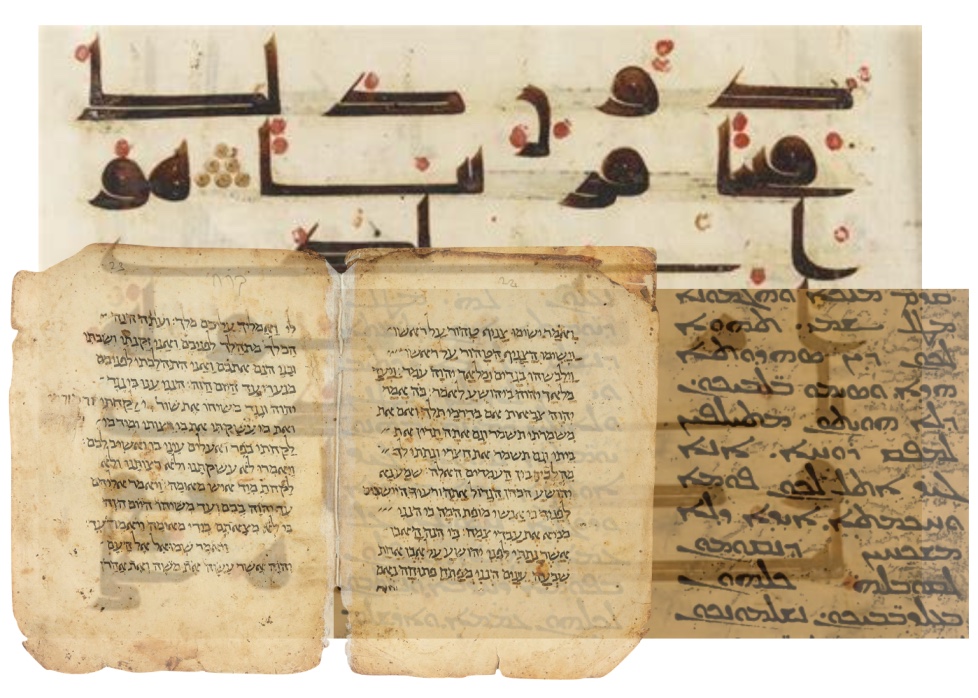
According to the Corpus Coranicum [3] research project at the University of Berlin-Brandenburg, which contains a unique collection of images of the early Qur’ān:
Himyarite and Axumite inscriptions, areas where major discoveries have been made over the past half-century, radically modify the chronology of some of the borrowings: it has been discovered that terms no less important than ṣalāh (‘prayer’) and zakāh were already used in Himyarite writing more than 200 years before Islam.
The Qur’ān’s borrowings from pre-existing texts, from which Qur’ānic themes such as sensual paradise, penal punishments, Ramadan, saving Abraham from fire by the angel Gabriel, and so on have been drawn, include:
1 The Fall of Adam and Eve
2 Adam’s repentance after the fall
3 Throwing Abraham into the fire
4 The Jews turned into monkeys and pigs
5 The Sanctity of Life
6 Sūrat al-Fātiḥa
7 Legal Penalties
8 The style of the Arab diviners
9 Paradise in the Qur’ān and in the writings of Mar Ephrem
10 ‘There is no god but He’
11 Jizya
12 How to fast in Ramaḍān
13 The presence of the name Muḥammad
14 Kufr [4]
Example 1: The Fall of Adam and Eve and His Repentance After the Fall
According to the Qur’an it seems that the angels did not accept God’s decision to create Man, and thus the angel Iblīs (Satan)[5] was expelled from heaven because – due to his pride – he did not wish to prostrate to Adam:
And when thy Lord said unto the angels: Lo! I am about to place a viceroy in the earth, they said: Wilt thou place therein one who will do harm therein and will shed blood, while we, we hymn Thy praise and sanctify Thee? He said: Surely I know that which ye know not [Qur’ān II (al-Baqara), 30]
And when We said unto the angels: Prostrate yourselves before Adam, they fell prostrate, all save Iblis. He demurred through pride, and so became a disbeliever. [Qur’ān II (al-Baqara), 34]
He said: What hindered thee that thou didst not fall prostrate when I bade thee? (Iblis) said: I am better than him. Thou createdst me of fire while him Thou didst create of mud. [Qur’ān VII (al-A‘rāf), 12]
According to the Islamic narrative: Iblīs was expelled from Paradise when he disobeyed God’s command.
The Islamic narrative acknowledges and emphasises that this prostration to Adam was a prostration of greeting, not a prostration of worship. But that God nevertheless commanded it, so if God commanded something it has to be obeyed. Iblīs disobeyed his Lord and went astray, and Adam sinned and asked forgiveness and God forgave him, but Iblīs protested against fate and said:
My Lord! because Thou hast made life evil to me, I will certainly make (evil) fair-seeming to them on earth, and I will certainly cause them all to deviate.[6]
‘Iblīs – God preserve us – disobeyed the command of his Lord deliberately, and Allah expelled him from His mercy and banished him as a punishment for him’.
The Islamic narrative explains that Iblīs was never one of the angels, and that this was an illusion that had become widespread among the public. So in order to get rid of this embarrassment, as usual, the mercurial and sacralising mentality crystallized some superstitions such as: Iblīs from the outset was a peacock among the angels and did not consider himself as just one among them. And they established the idea that Iblīs was a righteous jinn who worshipped Allah alongside the angels, but that when he was put to the test he fell, and when he was commanded to prostrate himself to Adam he became arrogant and said: “So I am to prostrate myself before one who was created from clay?”
The sources for this event are Judeo-Christian texts
It is mentioned in the Qur’ān that He was of the jinn, so he transgressed the commandment of his Lord, i.e., he was one of the obedient jinn and he disobeyed the command of his Lord, so he was therefore never one of the angels. All save Iblis. He was of the jinn. [Qur’ān XVIII (al-Kahf), 50]
But was Satan really one of the angels?
Some said that he was their father, just as Adam was the father of mankind. Iblīs is the father of the jinn, among whom are devils who are rebellious. But some others hold that the jinn are not angels, and that he used to pray with the angels and worship alongside them, but that when he rebelled, he became corrupted and arrogant, he cursed and was expelled and became one of their progeny. He is thus not one of the race of angels, for the angels’ element derives from the light, while his element stems from the fire. He is therefore neither one of them in element, nor in reality, but stood simply among them. When was commanded to prostrate, he did not do so, and puffed himself up, disobeyed, and was expelled by God, driven away, and cursed. On this Ibn Taymiyya and a number of others said:
He is one of the jinn, and he is their father, whom Allah created from a smokeless fire.[7] He is not one of the angels, but was with them in the heavens. He was once a worshipper but when he became arrogant he was expelled and cursed. We ask God to cure us!
Suggested Reading
In the Apocrypha, this protest against man stems from the elements of nature: the stars, the rivers, and the earth (see, among other things, the Revelation of Paul). Moreover, this creation occasions the fall of Satan as ‘the Fallen Angel’, because he refused to prostrate himself to Adam.
The sources for this event are Judeo-Christian texts: The Life of Adam and Eve:
God said to me, “Behold you must die, since you have transgressed the commandment of God, for you listened rather to the voice of your wife, whom I gave into your power, that you might hold her to your will. Yet you listened to her and ignored My words”[8]
and The Questions of St. Bartholomew:
And when I came from the ends of the earth Michael said: “Worship thou the image of God, which He hath made according to his likeness”. But I replied: “I am fire of fire, I was the first angel formed, and shall I then worship clay and matter?” Then Michael said to me: “Worship, lest God be wroth with thee”. But I said to him: “God will not be wroth with me; but I will set my throne over against His throne, and I will be as He is”. Then was God wroth with me and cast me down”.[9]
According to the Qur’ān Adam repented of his sin that led to his downfall, and God accepted his repentance. In this regard, Hisham Djait, a Tunisian researcher, traced the influence of Judeo-Christian sources on the Qur’ān:
Note that Adam’s repentance after the original sin is not found in the Old Testament but is found in the Talmud (Eruvin, 18b) as well as in the Life of Adam and Eve, in the Revelation of Moses, and in the Book of Enoch (the similarities between the Qur’ān and this last text are particularly frequent).[10]
[1] Ebionites (derived from the Hebrew word אֶבְיוֹנִים ebyōnīm, meaning ‘poor ones’), is a term adopted by the Church Fathers to refer to a Judeo-Christian movement that existed in the early days of Christianity, one which viewed Jesus as the Messiah but denied his divinity, insisted on following Jewish law, believed only in one of the Jewish Christian Gospels, venerated the ‘righteous James’, and did not recognize Paul, whom they considered an apostate. The name of this sect was associated with poverty as they were referred to as ‘the poor ones’ in the manuscripts of Khirbet Qumrān at the Dead Sea, distancing them from ‘the corruption of the Temple’. Most of the information about them comes from the writings of the Church Fathers who considered the Ebionites to be heretical Jews. There is disagreement as to whether the Ebionites and the Nazarenes are two different sects, or constitute a single sect as the Church Fathers believed. These last described this one sect as being called the Nazarenes while they were in Jerusalem, but which subsequently adopted the name ‘Ebionites’ after they had migrated to other regions. Some of the Church Fathers stated in their writings that the Ebionites took care to follow the commandments of Moses, considered Jerusalem to be the holiest city, and practiced the customs of circumcision and the Jewish Sabbath. They also rejected many of the doctrines of the Nicene Creed such as the eternity of Christ, his divine/human nature, his virgin birth, his crucifixion for the redemption of mankind, and his physical resurrection from his grave. They believed in the oneness of God and the human nature of Jesus as the biological son of the Virgin Mary and Joseph the carpenter, as one chosen by God for his piety to be an anointed (mashīch) prophet like Moses, and whom the Holy Spirit anointed with oil at his baptism. They believed that a divine power descended upon Christ at his baptism, but that this divine power departed from Jesus when he was on the Cross. Of the books of the New Testament, the Ebionites accepted only the Hebrew (or Aramaic) version of the Gospel of Matthew – referred to as ‘The Gospel of Hebrews’ – as a sacred text added to the canon of the Hebrew Bible, and allowed marriage from two to three times up to seven times. (Ed.)
[2] According to Early Christian and Manichaean sources, Elchasai or Elxai was the founder of the sect of the Elkesaites and the recipient of a book of revelation, the Book of Elxai. His is also said to be the belief followed by the parents of Mani. According to Epiphanius, Panarion 19, 2, 2, the name Elchasai means ‘Hidden Power’ (Aramaic: ḥail kesai). Eusebius in his Ecclesiastical History (composed in mid- 3rd c AD) notes the following about the Arabian peninsula and the Elkesaites: “Once more in Arabia …other persons sprang up introducing a doctrine foreign to the truth, and saying that the human soul dies for a while in this present time, along with our bodies, at their death, and with them turns to corruption; but that hereafter, at the time of the resurrection, it will come to life again along with them…There has come just now a certain man who prides himself on being able to champion a godless and very impious opinion, of the Helkesaites, as it is called … It rejects some things from every Scripture; again, it has made use of texts from every part of the Old Testament and the Gospels…and it says to deny is a matter of indifference, and that the discreet man will on occasions of necessity deny with his mouth, but not in his heart. And they produce a certain book of which they say that it has fallen from heaven”. (Eusebius, Ecclesiastical History, Book VI, XXXVII-XXXVIII). The book, according to Epiphanius, condemned virginity and continence and made marriage obligatory. It also permitted the worship of cult images to escape persecution, provided the act was merely an external one, disavowed in the heart. Prayer was to be made always towards Jerusalem. (Ed.)
[3] Corpus Coranicum is a research project of the Academy of Humanities in Berlin-Brandenburg that aims to develop a better contextual understanding of the Qur’ān in the West. Begun in 2007, the initial database for the first three years was created by the Department of Semitic and Arabic Studies at Al-Quds Free University. The aim is to present the Qur’ān via its manuscripts and oral tradition, as well as provide a comprehensive commentary that interprets the text in the context of its historical development. Most of the sources for this project consist of photographs taken of ancient handwritten Qur’āns by Gotthelf Bergträsser and Otto Pretzl before World War II. On 24 April 1944, the British Royal Air Force bombed the building where these photographs were stored in Berlin. Anton Spitaler, a specialist in Arab studies, claimed that the collection of photographs had been destroyed. However, at the end of his life, he admitted that he had hidden the photographs for almost half a century. He then took over the photographic archive of 12,000 photographs of handwritten Qur’āns.
[4] On this term, see Gallez’s article The root kfr and philology: significance and biblical, post-biblical and koranic meanings in the Almuslih Library here (Ed.)
[5] The association of Iblīs with Satan has been established as occurring due to the mediary language of Syriac, where the Greek translation of the Hebrew ‘Satan’ was διάβολος diabolos, which the Syriac readers parsed as ܕܝܒܠܘܣ d-ablūs – ‘of Ablūs’ – hence ‘of Iblīs’. Arthur Jeffery discusses this in his work The Foreign Vocabulary of the Qur’ān, and notes that in the New Testament the diabolos is ‘more than an adversary, and particularly in the ecclesiastical writers becomes the chief of the hosts of evil. It is in this sense that Iblīs appears in the Qur’ān, so we are doubly justified in looking for a Christian origin for the word.’ This is analogous to how Muslim authors wrote Idrīs for the Greek Ἀνδρέας mediated by a Syriac ܐܢܕܪܝܣ Indrīs. See, in the Almuslih Library, The Foreign Vocabulary of the Qur’ān, pp.47 and 52. (Ed.)
[6] Qur’ān XV (al-Ḥijr), 39.
[7] Qur’ān LV (al-Raḥmān), 15: And He created the jinn of a smokeless fire.
[8] The Life of Adam and Eve (Latin text sections XII-XVI).
[9] Questions of St. Bartholomew (section IV, 54-55). See Dictionnaire du Coran, sous la direction de Mohammad Ali Amir-Moezzi, article: Anges, Angéologie, Paris, éditions Robert Laffont, 2007, p.53.
[10] Hichem Djaït, La vie de Muhammad Vol.II – La prédication prophétique à La Mecque, Chapter V, Le problème des influences chrétiennes, Fayard, 2008, p.287.
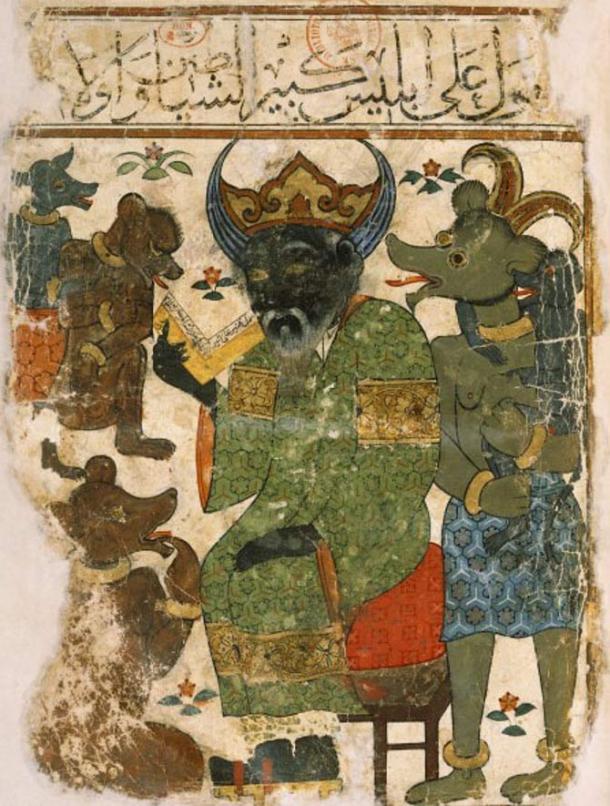
Main image: Medieval manuscript depiction of Iblīs, the ‘kabīr al-shayāṭīn‘
See Part One of this article here