The use of the word ‘martyr’ in relation to those who kill, or are killed, in God’s path and in defense of the Islamic faith may be considered a heresy and a fabrication against the name of God Almighty. For God makes no mention in the Qur’ān in any way that whoever is killed for His sake is to be considered a ‘martyr’, and this aside from the fact that He never mentioned the word shahāda – ‘martyrdom – with this sense and purpose.
BY KARZAN MUSTAFA SABIR
BUT THE ḤADĪTH COMPILERS, and those who trade in religion, fabricated it without any basis for that, in order to increase the unknowing in their ignorance and silliness. And, exasperatingly, this situation remains the same to this day, as the traffickers in religion push the stupid, the naïve and the religious minded towards death under the promise of ‘martyrdom’, attaining to heaven and cancelling out all their previous sins with a divine forgiveness.
And here we should note that our aim is not to defame the Companions of the Prophet of Islam who were slain. Our purpose is simply to clarify the fact that the word ‘martyr’ – shahīd – does not refer to that concept promoted by clerics in the name of God and the Qur’an, in their aim to deceive naïve people into believing that exposing themselves to death to upraise Islam constitutes ‘martyrdom’.
For the truth is that the word ‘martyr’ has nothing to do with war and killing. The Qur’ān does not adopt the word ‘martyr’ as some synonym for war and killing. Nor is the word used to refer to anyone – including the Prophet or any of the Companions – for their being killed in a war against the enemies of Islam.
The word ‘martyr’ has nothing to do with war and killing
I do hope that those who are backward and naïve will not blindly and illogically resort to hurling all kinds of rude and ugly words at use after we have fully explained what we mean, nor shower us with hundreds of ḥadīths and fabricated narrations about ‘martyrdom’, because we are well aware of those ḥadīths and will respond to them with evidence based on the text of the Qur’ān.
We openly declare that there is no mention of martyrdom or seeking martyrdom in the entire text of the Qur’ān, and most of the ḥadīths that deal with martyrdom derive from the ideas and formulations of individuals and not from the words of the Almighty and are far removed from the real meaning of martyrdom. For those individuals deliberately fabricated and formulated hundreds of other ḥadīths and qualified them as ḥadīths according to how much they confirmed transgressive acts that gained them power and protected their private interests.
Suggested Reading
These doctrines and conceptions prompted the simple and the naïve to revere these ‘ḥadīths’ and raise their status above the status and sanctity of the texts of the Qur’ān, and to follow their nonsensical sayings in place of following the Qur’ānic text, whereas God Almighty says:
And We have revealed the Book to you explaining clearly everything, and a guidance and mercy and good news for those who submit.[1]
Enlightened believers should be aware that no human being, the prophets included, can surpass the greatness of God in His understanding, His discernment and His knowledge. There is no excuse for those who act as God’s deputies to deviate from the teachings of the Qur’ān and consider the dead to be ‘martyrs’. To these we say: the guidance and direction of the Islamic faith is not from the people but from the Qur’ān alone. If you, as a believer, hold that clerics are more discerning, wise, and knowledgeable than God, and if you take individuals as your guide rather than God, then by all means feel free to utter any amount of obscenities!
The term ‘martyr’ in the Qur’ān means ‘witness’, a witness to something, as someone present when something occurs, or observes it closely. It has the sense of a documentary proof (a witness of evidence, of a quotation, of proof – or a false witness – a witness of something heard or listened to, an eyewitness or witness of a denial). And it has several other meanings, all of which associated with giving testimony rather than ‘seeking martyrdom’.
The term ‘martyr’ in the Qur’ān means ‘witness’
We shall establish this with some hard evidence, and it is up to those who revere the Qur’ān and place their reliance upon on it to refrain from using the term ‘martyr’ to a person that has been killed, because God Almighty never used it to refer to anyone killed in the cause of raising high His word in the way clerics, and those who mislead the simple and the naïve, misuse the term.
At this point I feel it is right, before delving into a host of opinions, to give a brief summary of the words shahīd and shāhid as mentioned in the Qur’ān, since they differ in meaning and in the structure of the word. The word shahīd refers to a person who is present at the time of an event, that is, someone who saw or heard the event in question. For example, the person who is present when signing a contract, in Qur’ānic language is called a ‘witness’ – shahīd – with its plural shuhadā’. So I think that it is appropriate to reference a verse that mentions the two terms together, in their singular and plural forms, as here in the Almighty’s words:
that you may be witnesses to the people and (that) the Messenger may be a bearer of witness to you.[2]
However, it is not necessary for the witness to be aware of an event, or to have witnessed it as it occurred, and instead rely on one’s perception, premonition, mindfulness or conception of it when giving testimony. An example of this occurs in the verse which mentions how the witness did not see anything but testified to it based on his experience, as in the case of the Prophet Yūsuf when he said:
She sought to make me yield (to her); and a witness of her own family testified: If his shirt is rent from front, she speaks the truth and he is one of the liars.[3]
To demonstrate what we are getting at, Muslims to this day develop a thought and opinion on something without actually observing it first hand – as they testify and cite their shahāda, repeating the phrase:
I bear witness that there is not god but Allah, and I bear witness that Muḥammad is the Messenger of Allah.[4]
So in order to grasp the truth other than through fear of something or emotional affectation, we are to think and meditate on God’s commands and narratives and analyse them. So when Almighty God did not term those killed for His sake as ‘martyrs’, but instead termed them simply as ‘slain’. Given His use of the work ‘slain’ here, one should ask by what law and on what basis was He impelling those fighting towards their death that they may later be termed ‘martyrs’? Do modern cleric warriors have a rank and status higher than that of the Companions of the Prophet, for them to be termed ‘martyrs’ while the slain mujāhidīn among the Companions of the Prophet of Islam were referred to simply as ‘killed’? To make our point we may cite the following verse:
Think not of those, who are slain in the way of Allah, as dead. Nay, they are living. With their Lord they have provision.[5]
If what is meant here is ‘seeking martyrdom’ (istishhād) and that God Almighty considered His slain fighters ‘martyrs’ (shuhadā’), then He would have expressed this in the Qur’ān as follows:
Think not of those, who have sought martyrdom in the way of Allah, as dead. Nay, they are living. With their Lord they have provision.
So to attach the word ‘martyr’ to those who are killed in God’s cause is a violation of His command, for God has not employed anyone as an intermediary agent to manipulate His commands, change His Islam, and make the slain a ‘martyr’. God Almighty did not extend this term to cover the common folk, nor even to the Prophet of Islam, as when He said:
And Muḥammad is no more than a messenger; the messengers have already passed away before him; if then he dies or is killed will you turn back upon your heels? And whoever turns back upon his heels, he will by no means do harm to Allah in the least and Allah will reward the grateful.[6]
By saying in this verse: if then he dies or is killed, Almighty God is not considering His Messenger to be a ‘martyr’ should he be killed. If ‘seeking martyrdom’ existed with God, He would more appropriately have said: if then he dies or has sought martyrdom. Here we may ask what pretext or heavenly law grants the status of a martyr to fallen fighters, while Almighty God did not grant that rank to His own Messenger?
There is no mention of martyrdom or seeking martyrdom in the entire text of the Qur’ān
One should note that one of the most beautiful names of Good is ‘the witness’ – al-shahīd –mentioned in the Qur’ān with various forms and meanings: shuhadā’, shahīd-an, istashhadū, shahīdayn, shahāda, shahada, fa-’stashhadhū, shāhidayn, shāhid-an and so on. However, none of these meanings mentioned in the Qur’ānic verses carries the sense of killing individuals or seeking martyrdom, as portrayed to us by the clerics. To prove what we are saying and intending to demonstrate, we may cite some of the verses where these words are mentioned, such as the words of the Almighty here:
that Allah may know those who believe and take witnesses from among you; and Allah does not love the unjust. [7]
Here, the word witnesses here (shuhadā’) does not carry the sense of martyrdom as a result of fighting and killing, for God makes the believers witnesses to the course of events, and this is as far as possible from making the believers martyrs in the sense of annihilation and death, as some popularisers like to understand it.
The same goes for some of the ready available sources such as the Simplified Commentary of Muḥammad Amīn’s Al-Burhān which in all of its nineteen editions explains this verse as ‘so that they may attain the status of martyrdom’. Yet this verse does not in any way address the issue of a martyr or martyrdom, and we do not know where the writer got the idea of martyr from to stick it into his interpretation of this verse. And it is not as if we are alone in our interpretation of this verse, for here is Muḥammad Ḥusayn al-Ṭabāṭabā’ī in his work Al-Mīzān fī Tafsīr al-Qur’ān sharing our opinion on this:
‘Martyrs’ are witnesses of deeds, but martyrs in the sense of those killed in battle are nowhere mentioned in the Qur’ān, and has become a recent Islamic coinage.[8]
The word ‘martyrs’ (shuhadā’) ” is mentioned in this verse as well:
Or were you witnesses when death visited Yaqoub, when he said to his sons: What will you worship after me? [9]
And here the word has nothing to do with seeking martyrdom or killing, since it carries the meaning of being present, that is: that you attended Jacob’s ‘death agonies’ when he said to his sons, “What will you worship after me?” And again, we have the verse:
Thus We have made you a medium (just) nation that you may be witnesses to the people and (that) the Messenger may be a bearer of witness to you. [10]
The words shuhadā’ and shahīd-an (‘witnesses’ and ‘witness’) have nothing to do with killing or seeking martyrdom, and in analysing this verse it becomes clear to us that Muḥammad is a witness to his Nation, and a witness of those witnesses of his Nation. Or understanding of the Arabic language of the Qur’ān leads us to this meaning. See also this verse:
O you who believe! be maintainers of justice, bearers of witness of Allah’s sake, though it may be against your own selves. [11]
Here, too, the word shuhadā’ carries the sense of giving testimony, that is, observe carefully and be just in your giving testimony, even if it should be against yourselves. It is the same in the verse:
The month of Ramadan in which was revealed the Qur’an, a guidance for mankind, and clear proofs of the guidance, and the Criterion (of right and wrong). And whosoever of you is present, let him fast the month.[12]
The word shahida ‘bore witness’ is mentioned in the sense of ‘observed’ and therefore in this verse has nothing to do with killing or martyrdom as a result of an act of killing. The word is used in the next verse in the same way, as an instruction in the Qur’ān concerning the religion, and where the words istashhadū and shuhadā’ have nothing to do with martyrdom or seeking martyrdom:
O ye who believe! When ye contract a debt for a fixed term … call to witness, from among your men, two witnesses. And if two men be not (at hand) then a man and two women, of such as ye approve as witnesses. [13]
That is, to bear witness to this by means of two witnesses – ‘witnesses’ that is, not ‘martyrs’. See also the following verse:
Till, when they reach it, their ears and their eyes and their skins testify against them as to what they used to do. [14]
Here, the word shahida means the testimony of the ears, the skin and one’s sight. In the following verse the term shuhadā’ occurs:
And those who accuse free women and then they do not bring four witnesses, flog them eighty stripes, and do not admit any evidence from them ever; and these it is that are the transgressors.[15]
It carries the sense of giving testimony concerning the act of adultery and has nothing to do with killing or martyrdom, so that the verse is explaining that those who fabricate the charge of adultery against reputable women, without being able to bring four witnesses to verify that act, are to be flogged 80 times, and their testimony dismissed outright.
And when it states: and then they do not bring four witnesses this clearly does not mean bring four dead people, but clearly bring four living witnesses to this act of adultery. For further clarification, let us take the phrase:
and Allah is of all things the Witness.[16]
In this verse God Almighty is saying: ‘I bear witness to everything’, that is, I am a witness and a knowing sage. He does not mean ‘a martyr’ in the sense that it has come to be firmly rooted in the mind and imagination of some. This verse is proof of what we are getting at:
And David and Solomon, when they gave judgment concerning the field, when people’s sheep had strayed and browsed therein by night; and We were witnesses to their judgment. [17]
Here Almighty God gives His voice to testify for David and Solomon about the decision that David and Solomon made regarding the field,[18] so much so that the Qur’ān, through the mouth of ‘Īsā the son of Mary, states:
I was a witness of them so long as I was among them, but when Thou didst cause me to die, Thou wert the watcher over them, and Thou art witness of all things. [19]
Here God Himself bears His testimony that He is the watcher and witness of all events. Some may ask – given that God is the Knower of all things, and in His own words: Allah is of all things the Witness[20] – where is the need for the testimony of others? And why was the Prophet of Islam sent to bear witness against individuals, as in this verse:
O Prophet! surely We have sent you as a witness, and as a bearer of good news and as a warner.[21]
In another verse, God says to His servants:
Surely We have sent to you a Messenger, a witness against you.[22]
He even calls upon his people to be witnesses, that is, witnesses to other people, and makes the Prophet act as a witness against these, as in this verse:
Thus We have made you a medium (just) nation that you may be witnesses to the people and (that) the Messenger may be a bearer of witness to you.[23]
Why the Prophet of Islam was sent to bear witness against individuals is a legitimate question and will probably take some time to explain, but we do not think it appropriate here to delay the reader on this. For the aim is not to raise such questions here, our main goal being that everyone should realize the unassailable fact that God did not use istishhād – ‘seeking witness’ in the sense of seeking death, as some prefer to understand it. Note also the following verse:
Allah has bestowed favours from among the prophets and the truthful and the martyrs and the good. [24]
God Almighty here says ‘martyrs’, but He means those who testify to others. If we truly believe and depend on the Qur’ān we cannot bestow upon any of those who have died the word ‘martyr’. Just to give one example, we might ask some clerics about this verse that they have taken up: Did the Prophet of Islam receive the title of Prophet after God caused him to pass away? Or did he win the title while he lived, as did the other prophets who won the title of prophet while they were still alive and making a living. The same goes for those who believed and were called ‘righteous’, in the same way that witnesses were called ‘martyrs’ while they were alive. For more details about the interpretation of this verse, and in order to reach the truth of the matter, we might make use of the commentary of Al-Manār [25] as well as Shaykh Muḥammad ibn Ṣāliḥ al-Uthaymīn’s interpretation of this verse, where he states:
‘Martyrs’, those who were made martyrs by Allah for His created people, for they bear witness to the truth and bear witness to them. We also say that this Nation are martyrs for people in general, because God says: Thus We have made you a medium (just) nation that you may be witnesses to the people.
Similarly, Shaykh ‘Alī al-Faḍl ibn al-Ḥasan al-Ṭabarsī mentions in his book Majma‘ al-Bayān fī Tafsīr al-Qur’ān when interpreting the phrase and the martyrs in this verse:
The ‘martyr’ was so called because he testified sincerely to the truth, he acknowledged it and called to it until he was killed. It was said that he was called a ‘martyr’ because he is one of the witnesses of the Hereafter against the people. God makes them martyrs for their virtues and nobleness. [26]
We can also be enlightened by the thought of the famous Islamic thinker Dr. Muḥammad Shaḥrūr who support this academically through evidence, proving that the word shuhadā’ in this verse does not bring with it the sense of shahīd.
To confirm this point and demonstrate what we have been pointing out – that Almighty God did not consider any of the dead to be ‘martyrs’, including those who were killed for His sake – God mentions them as ‘the dead’. As an indication of this we might mention the following Qur’ānic passage as evidence for our conclusions for a correct interpretation, one that cannot be given an alternative interpretation through any lexical evasion:
They fight in Allah’s way, so they slay and are slain.[27]
It is without a shadow of a doubt that had the Qur’ān intended the status of a martyr or of martyrdom in the sense referred to by the clerics, then Almighty God would have provided clear evidence of this and removed any confusion in the first place, and would have said: so they slay and seek martyrdom.
Fabricated ḥadīths on the status of the martyr and of martyrdom emerged, fashioned by clerics and ḥadīth collectors
Even so, and despite all of this, hundreds of strange, confusing, fabricated ḥadīths on the status of the martyr and of martyrdom emerged, fashioned by clerics and ḥadīth collectors without any reliable train of narration. Their purpose was to defend and perpetuate private interests and provoke those fighting on their behalf. The problem, which persists to the present day, is that the traffickers of religion are benefitting and deriving power from these fabricated ḥadīths, which to encourage, goad, exploit and fool the ignorant, impelling them towards killing and dying, purely to secure their own goals and interests.
While the truth is that none of these ḥadīths are founded upon on any divine message, and some of them even contradict each other. So as not to detain the reader too long, we will present two hadiths as examples. The first of these is the ḥadīth collected by Imam Muslim that makes out that the Prophet of the Muslims had openly spoken of the act of martyrdom:
It has been narrated on the authority of Abu Huraira that the Messenger of Allah said: “One who is slain in the way of Allah is a martyr; one who dies of plague is a martyr; one who dies of cholera is a martyr … one who is drowned is a martyr. [28]
In one of his hadiths, Imam Bukhārī talks about the dead of the battle of Badr, and that in response to Abū Sufyān’s question the Prophet of Islam is to have replied as follows:
Get up, ‘Umar, and answer him and say, “Allah is the Most High, the Most Exalted, and there is no equivalency between our slain who are in Heaven and their slain who are in Hell” [29] [30]
If this were indeed the case, it would have been better to say:
Our martyrs who are in Heaven and their slain who are in Hell.
But we leave the interpretation and observations to the clerics regarding the difference between the two statements, as to which of the two is the more believable.
It is however important to note here that according to the teachings of the Sharī‘a and the Islamic sources, in addition to what we are told by the ḥadīths, that a non-Muslim who exposes himself to death, even if it is for the sake of defending the land of Muslims or protecting his land or for the sake of any of its sanctities, will not only not be recorded as a ‘martyr’ but will die as an infidel, and his fate will be Hellfire.
To prove this we could narrate here the story of the incident of Quzmān ibn al-Ḥārith’s murder. He was a resident of Yathrib/Medina who did not participate in any battle because he was not a believer in Islam and Islamic sources indicate that he died a Jew. Now when the noble Muslims vacated their posts in order to covet the spoils, Khālid ibn al-Walīd – at a time previous to his becoming a Muslim –launched an attack on them from behind.
Suggested Reading
As a result, the Muslim army was defeated and its members took refuge by fleeing into the mountains. When Quzmān ibn al-Ḥārith saw that the town was emptied of men, with some of them in disarray and others hiding themselves, and only women were left, he took decisive action to defend his town and its people and the honour of its womenfolk, and confronted the enemy, fighting them valiantly. Islamic sources indicate that he managed to kill six or seven attackers, but was fatally wounded in the process, although some sources indicate that he committed suicide from of the pain of his wounds. When news of this reached the ears of the Prophet of Islam he said:
This is proof that I am fighting for the Truth, for Allah has harnessed the disbelievers to serve the Muslims, and Quzmān is not a martyr but an infidel whose fate is Hell because he was not a Muslim.
For more on these events, you may consult these sources. [31] [32]
The hadith of the Prophet of Islam about Quzmān ibn al-Ḥārith is another evidence that indicates to us that if a non-Muslim defends the land of Muslims or his territory and his honour and is killed in so doing, he is an infidel and his fate is Hellfire. According to this ḥadīth of the Prophet of Islam and according to Islamic law , Christian soldiers, Kākā’īs, Zoroastrians and Yazidis, who sacrificed their lives for the sake of the homeland and their honour, and all who are not of Islam, are not infidels, nor are they to be numbered among the people of Hell.
As we have pointed out, we do not believe in the ‘martyrdom’ concept that some clerics invented without any evidence from the Qur’ān. We see it as only right and necessary to dispense with these distinctions on the basis of religion and to exalt the noble status of Muslims, and others, who have given their lives willingly to defend the plight of their country, and call all of them of immortal memory instead of using this term ‘martyr’. For whoever has given his life to protect his homeland is immortal and will remain so forever.
Right from the outset sectarians deliberately introduced the concept of ‘martyr’ to ensure the flow of warriors and incite them to fight. They fabricated dazzling tales of the martyrs, and these tales had an effective, influential impact on morale during the course of the battles. However, the traffickers of religion persisted in their preoccupation with the status of the martyr in order to ensure yet more fighters, until a point was reached where Muslims killed each other in order to achieve that status of martyrdom and gain the privileges that it was portrayed as assuring them. And to this day Shi‘ite Muslims go out to fight Sunnīs and kill them.
Sectarians deliberately introduced the concept of ‘martyr’ to ensure the flow of warriors and incite them to fight
The same goes true for Sunnīs who kill Shi‘ites, and those killed on either sides are called ‘martyrs’.
We saw ISIS militants killing and being killed, oblivious to the fear of death in their confidence in gaining the prize of martyrdom. It is indeed passing strange that the killers and those killed prayed prostrated to God, each fighting each other to make their God triumphant and obtain martyrdom – even while they all worshipped the same God and none other. This excessive preoccupation with the subject of martyrdom, and the sanctity and status of martyrdom in Islam, has impelled Muslims to fight among themselves in order to obtain it, when all are in fact unable to determine whose side God is on. Is He with the Shi‘ites or the Sunnīs? Or is He with the Salafīs or the Wahhābīs? With Hizbollah or the Muslim Brotherhood? With the Anṣār Allāh or with the ISIS militants? Or do you think He is on the side of the Aḥmadis or with Boko Haram” Or with al-Qaeda or Jabhat al-Nuṣra? Or is He with the Taliban on the side of Saudi Arabia or Iran?
As for myself, I am confident that Almighty God is innocent of all of these, because they are all the creation of traders in religion, seeking to secure their own interests. They have deliberately exploited the alleged status and rank of the ‘martyr’ to deceive others and guarantee the supply of fighters.
Suggested Reading
By way of conclusion, from the window of our faith in Almighty God, we turn to these clerics and popularisers and bid them not to work for their own interests under some pretext of defending God; not to deceive the gullible youth, nor drive them towards death, because the True God has no need of anyone to defend Him.
Most grievous of all is this resort to bribing His servants that if they stained their hands with each other’s blood, and killed their brothers, they will be rewarded with alcohol and young serving boys.
As for you, the genuine believers, please respect God’s verses over against the teachings of individuals. Think with your minds and not with the minds of others. If Almighty God does not consider a prophet or his companions killed to have gained ‘martyrdom’ then what is making you fight for this status of martyrdom? God Almighty loves all of His servants, and He wants everyone to live happily and peacefully, in place of fighting and shedding blood.
[1] Qur’ān XVI (al-Naḥl), 89.
[2] Qur’ān II (Al-Baqara), 143.
[3] Qur’ān XII (Yūsuf), 26.
[4] Shaykh al-Jalīl al-Aqdam al-Ṣadūq Abī Ja‘far Muḥammad ‘Alī ibn al-Ḥusayn ibn Bābawayh al-Qumī, التوحيد, Dār al-Ma‘rifa lil-Ṭaba‘a wal-Nashr, Beirut, p.240.
[5] Qur’ān III (Āl ‘Imrān), 169.
[6] Qur’ān III (Āl ‘Imrān), 144.
[7] Qur’ān III (Āl ‘Imrān), 140.
[8] Sayyid Muḥammad Ḥusayn al-Ṭabāṭabā’ī, Al-Mīzān fī Tafsīr al-Qur’ān, منشورات الأعلمي للمطبوعات، بيروت لبنان 1st Ed.Vol. 4, p.31.
[9] Qur’ān II (Al-Baqara), 133.
[10] Qur’ān II (Al-Baqara), 143.
[11] Qur’ān IV (Al-Nisā’), 135.
[12] Qur’ān II (Al-Baqara), 185.
[13] Qur’ān II (Al-Baqara), 282.
[14] Qur’ān XLI (Fuṣṣilat), 20.
[15] Qur’ān XXIV (Nūr), 4.
[16] Qur’ān LXXXV (Al-Burūj), 9.
[17] Qur’ān XXI (Al-Anbiyā’), 78.
[18] The context of this Qur’ānic tale is the judgement by David and Solomon concerning an incident when some sheep had overrun a field and eaten the crops, whereby the sheep should be given to the owners of the field provided that the price of the sheep was equal to what had been destroyed. (Ed.)
[19] Qur’ān V (Al-Mā’ida), 117.
[20] Qur’ān LXXXV (Al-Burūj), 9.
[21] Qur’ān XXXIII (Al-Aḥzāb), 45.
[22] Qur’ān LXXIII (Al-Muzzammil), 15.
[23] Qur’ān II (Al-Baqara), 143.
[24] Qur’ān IV (Al-Nisā’), 69.
[25] Muḥammad Rashīd Riḍā, تفسير القرآن الحکيم , Vol. 5, First Ed., Maṭba‘at Al-Manār, p.240.
[26] ‘Alī al-Faḍl ibn al-Ḥasan al-Ṭabarsī, مجمع البيان في تفسير القرآن , Vol.3, Dār al-Ma‘rifa lil-Ṭaba‘a wal-Nashr, 3rd Ed., p.112.
[27] Qur’ān IX (Al-Tawba), 111.
[29] Ibn Hishām, Al-Sīra al-Nabawiyya, Part 3, Dār al-Kitāb al-‘Arabī, Beirut, 3rd Ed., p.56.
[30] Ṣaḥīḥ al-Bukhārī, Dār Ibn Kathīr lil-Ṭaba‘a wal-Nashr wal-Tawzī‘, Damascus, Ḥalbuni and Beirut, Burj Abī Ḥaydar, 1st Ed., Kitāb al-Tafsīr, Section: إذ يبايعونک تحت الشجرة p.1221.
[31] Dr. Mūsā Shāhīn Lāshīn, فتح المنعم شرح صحيح مسلم، کتاب الايمان , Vol. 1, First Ed., Dār al-Sharq, Beirut, Section: ‘None but a Muslim soul may enter Paradise, and Allah maintains this religion even through those who are debauched’, Ḥadīth 191, p.365.
[32] Shihāb al-Dīn Abū al-Faḍl Aḥmad ibn ‘Alī ibn Muḥammad, الأصابة في تميز الصحابة, Vol.3, Parts 5 and 6, Dār lil-Kutub al-‘Ilmiyya, Beirut, Chapter: ق – ز , Ḥadīth 7101, p.240.
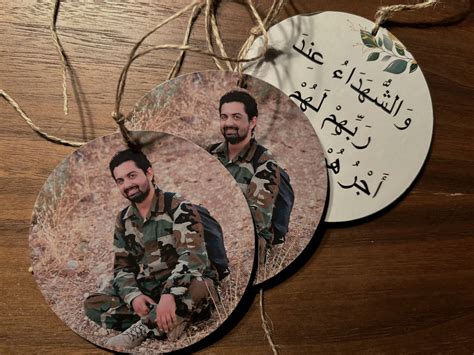
Main image: Amulets carrying a portrait of a fighter ‘martyred’ in God’s path. The inscription is from Qur’ān LVII (al-Ḥadīd), 19: وَٱلشُّهَدَآءُ عِندَ رَبِّهِمْ لَهُمْ أَجْرُهُمْ وَنُورُهُمْ “and the martyrs are with their Lord; they have their reward and their light”.