Muslims are fond of claiming that Islam respects reason and that God is known through reason. But their actions do not suggest any significance granted to the intellect. For example, the name Muḥammad ibn ‘Abd Allāh’ is never mentioned without the Muslim believer parroting the phrase: صلّى الله عليه وسلّم ‘peace be upon him’ (lit. ‘May God pray for him and grant him peace’).
AT TIMES this repetition reaches the level of absurdity when a person repeats the phrase thirteen times on a single page of a book. What is this prayer that Muslims demand for the Prophet?
The Kuwaiti Encyclopedia says that ‘prayer has its origin in the language: it is a du‘āh – ‘supplication’ – because the Almighty said:
Take alms out of their property, you would cleanse them and purify them thereby, and pray for them; surely your prayer is a relief to them. [1]
That is, pray for them. A ḥadīth runs as follows:
When you are invited (to eat) then reply to the invitation. If you are fasting then invoke Allah’s blessings (on your host), and if you are not fasting, then eat.[2]
That is, if he is fasting, let him pray for the providers of the food. So prayer is a supplication, as is bowing the head and prostrating.
The word is taken from the Aramaic term ܨܠܝ ṣ-l-y with the meaning of bowing and prostrating. According to the mediaeval philologians:
الصلاة al-ṣalāh (‘prayer’) comes from الصلوين al-ṣalwayn, the two parts bordering the tail-bone,[3] of the she-camel or other beasts, or the first joint of a human’s buttocks, the joints of the coccyx. The مصلّي muṣallī horse is one which follows a preceding one (i.e a second in line), for his head follows the rump (the behind) of the horse in front of it.
The same can be said for those muṣallīn in the congregational prayer, in that the head of each muṣallī is behind the rump of the person prostrating in front of him.
Al-Qurṭubī says in his Commentary:
Allah commanded His servants to pray for His prophet Muḥammad rather than the other prophets, as a mark of honour to him. It is beyond dispute that praying for him is obligatory once in a lifetime, and it has always been one that one of the obligations is follow confirmed sunnas like this which are only omitted by those who have no good in them. And if you ask whether the prayer for Allah’s Messenger is obligatory or just recommended, I say that it is obligatory. There are differences as to the circumstances of its obligation, some holding that it is to be said every time the Prophet is mentioned. There is a ḥadīth that states: ‘If ever I am mentioned in one’s presence and he does not pray for me, he has entered Hellfire and Allah has rejected him’.
Prayer, for all its veneration of God, is a supplication by which the worshipper prays to his Lord to have mercy on him or on someone else. Prayer, as a ritual of worship, has been known to people since ancient times. All ancient societies – the Akkadians, Babylonians, Sumerians, the ancient Egyptians, the Amerindians and others – had their own forms of prayers by which they drew near to their gods. The Qur’ān says this about the pre-Islamic Arabs:
Their prayer before the House is nothing but whistling and clapping of hands; taste then the chastisement, for you disbelieved.[4]
Prayer, then, is not a specifically Islamic form of worship, and there is no reason why Allah should limit it to Muḥammad and not to the rest of the prophets.
There are other types of prayer that the Qur’ān mentions, without showing us how to perform them:
Hast thou not seen that Allah, He it is Whom all who are in the heavens and the earth praise, and the birds in their flight? Of each He knoweth verily the worship and the praise.[5]
Prayer from Allah is a mercy. For his creatures – the angels, human beings and the jinn – it is about standing, bowing, prostrating, supplicating and glorifying; while the praying of the birds and humming-birds is about glorifying.
Prayer from Allah is a mercy. For his creatures – the angels, human beings and the jinn – it is about standing, bowing, prostrating, supplicating and glorifying; while the praying of the birds and humming-birds is about glorifying.
We do not know how Ibn al-‘Arabī managed to define that the prayer of the angels and the jinn is standing, bowing and prostrating, while the prayer of the bird is glorifying. Ibn al-‘Arabī certainly never saw angels and jinn kneeling or prostrating, nor could he understand the language of birds and humming-birds enough to assure us that their prayer is a glorification. There is no doubt that it all comes from the fertile imagination of the clerics.
There are many types of Muslim prayer; he prays for the deceased, he prays out of fear when a solar or lunar eclipse occurs, he prays for water when the sky is niggardly with its rain, and he prays the istikhāra prayer asking God to help him make a right decision. All these prayers are nothing but supplications to Allah to respond to their requests, and the form of these prayers is well known.
Does God call upon other forces to have mercy on the believers when He prays for them?
But how do they pray to the Prophet? A Muslim certainly does not read the Qur’ān or kneel when he prays to the Prophet, so is his prayer a supplication to Allah to have mercy on Muḥammad and admit him to Paradise? Muḥammad told them that God had chosen him from among all the sons of Adam to be His favoured Messenger, and had granted him the right to award some people the good news of Paradise. He told his Companions that his vessel in Paradise could accommodate everyone. He is therefore one of those with whom Allah is pleased, and whom He leads to Islam, vouchsafing him Paradise and bestowing upon him wealth and progeny.
What else does a Muslim supplicate for? Whoever prays to Allah to have mercy on Muḥammad and be kind to him would surely by like someone selling water in a district of water-sellers.
Allah is more merciful to His Prophet than the Muslims. What is more, Muslims do not say, “O Allah, pray for Muḥammad”, since this would be asking for mercy for him. Instead they say, “Peace be upon him”. ‘Pray’ in the phrase “O Allah, pray for Muḥammad” is rendered in the past tense, indicating that He has prayed and completed his prayer for Muḥammad.
If this is the case, what is the point of repeating an action that has happened and is concluded? Some will say that the past tense here means the present tense, in the way that we say “God forgave ( غفر ) him” when we mean “may God forgive ( يغفر ) him”. But why do we use the past tense and mean the present tense? Why don’t we use the present tense if we mean it? But it is the tragedy of the Arab to say one thing and mean another, and the Qur’ān is full of this kind of thing.
The whole story of praying for the Prophet began with a Qur’ānic verse that runs:
Surely Allah and His angels bless the Prophet; O you who believe! call for blessings on him and salute him with a deep salutation. [Qur’ān XXXIII (al-Aḥzāb), 56].
The sūra of al-Aḥzāb is a Madinan sūra that followed the Battle of Al-Aḥzāb that took place in the fifth year of the hijra. The prayer for the Prophet did not begin until the eighteenth year of the beginning of the Mission. What was it that was new at the time that Allah should ask the believers to pray for their Prophet? Was it really an obligation to pray for Muḥammad to the exclusion of the rest of the prophets, as al-Qurṭubī says? The mind remains confused as to why it should be obligatory to pray only to Muḥammad and not to the rest of the prophets and messengers, even though God said that Abraham was His beloved and that Moses was His mouthpiece to whom He spoke to directly without an intermediary, and that Jacob was one of His finest prophets, to the extent that He made all the prophets descend from his line, with the exception of Muḥammad, and that Jesus was part of His own spirit that he breathed into Mary’s faraj.[6]
Suggested Reading
Why perchance is the request for mercy limited to Muḥammad alone? If this is true, why do Muslims say in their supplication: “O Allah, pray for Muḥammad and the family of Muḥammad, just as thou didst pray for Ibrāhīm and the family of Ibrāhīm?” Is it reasonable for Allah, who prayed for Ibrāhīm and his family, to limit people’s prayers to Muḥammad only?
If prayer is a supplication for mercy, how can Allah pray for all believers, as the Qur’ān says:
He it is Who sends His blessings on you, as do His angels, that He may bring you forth out of utter darkness into the light; and He is Merciful to the believers.[7]
The Qur’ān also says:
Who, when a misfortune befalls them, say: Surely we are Allah’s and to Him we shall surely return. Those are they on whom are blessings and mercy from their Lord, and those are the followers of the right course.[8]
Does God call upon other forces to have mercy on the believers when He prays for them? Or is it His prayer for them that is His mercy for them? If so, why does He pray, that is supplicate, the angels to pray for mercy for the believers when He has asserted that He is in any case having mercy on them, because He said He is praying for them? Why did He ask the Prophet to pray for those who give charity:
Take alms out of their property, you would cleanse them and purify them thereby, and pray for them; surely your prayer is a relief to them? [9]
Since prayer is a supplication, why limit supplication to Muḥammad? For it is permissible for a believer to pray to Allah to have mercy on whomsoever He chooses, for Allah has the right to have mercy on him or not, even though He prays for all believers.
The ḥadīth collections tell us about the ḥadīth of ‘Abdullah ibn Abī Awfā which runs:
It was the practice of the Messenger of Allah, when the people brought to him ṣadaqa, to say: “O Allah, pray for them”. So when Abū Aufā brought him ṣadaqa he said: “O Allah, bless, the posterity of Abū Aufā”.[10]
The request of God to pray for His creature is not limited to the Prophet, as al-Qurṭubī illustrates. If God’s prayer for the believers is His mercy for them, how can we explain what happened to the millions of believers who seem to have suffered the most severe types of death in earthquakes, tsunamis and famines, some of them children who are yet to be guilty of anything? What happened to God’s prayer for the believers?
Ibn al-Athir writes:
When Allah Almighty commanded us to pray for the Prophet and we are unable to fulfil our obligation to the full, we refer it to Allah and say: “O Allah, pray for Muḥammad, for You know best what is appropriate for him. There are differences of opinion on this type of supplication. Is it absolutely possible for anyone other than the Prophet or not? The fact is that it is exclusive for him and for none other.
We have seen in the previous paragraphs that prayer is not limited to Muḥammad. But how can Ibn al-Athīr say that the Muslims’ prayers for Muhammad did not fulfil their obligation to the full, so they asked Allah to pray for Muḥammad Himself, in that He would know what was appropriate for him? Did God not know that their prayers would not fulfil their obligation to the full, given that it was He who commanded them to pray for Muḥammad?
The ḥadīth scholars expressed their view on praying for the Prophet:
When it was said to the Prophet: “Have you seen the saying of Allah Almighty: Allah and His angels pray for the Prophet”? he replied: “This is a hidden knowledge, and if you had not asked me of this, I would not have spoken to you about it. For Almighty Allah entrusted me with two angels, so that whenever a Muslim remembers me and prays for me the two angels will say: “May Allah forgive you”. And in response Allah and His two angels will say “Amīn”. And whenever a Muslim remembers me but does not pray for me the two angels will say: “May Allah not forgive you”, and in response to those two angels Allah will say “Amīn”.[11]
It is clear that this ḥadīth runs completely contrary to reason because its words are not worthy of the greatness of a Creator God. The word amīn in the language signifies a request for acceptance. When the imam calls and the worshippers behind him say amīn they are asking God to answer the supplication, for it literally means ‘respond’. If the two angels entrusted to Muḥammad say to the Muslim who prays for him: “May Allah forgive you” how can God then say amīn, that is “respond!” From whom is God asking for a response?
Another hadith says:
Whoever prays for me, the angels will pray ten times for him.
So the angels who say amīn in response to these two angels thus pray ten times for every Muslim who prays for Muḥammad. So the millions of people who pray for Muḥammad dozens of times a day are prayed for by angels ten times as many as they do. How long the angels’ day must be! Worse than that, anyone who does not pray for Muḥammad enters the flames of Hell and Allah will reject him, as the ḥadīth of the Prophet runs:
Whosoever remembers me and does not pray for me, he will enter Hellfire, and Allah will reject him.
Isn’t this a most cruel punishment for a believer who is not supplicating God to pray for Muḥammad, knowing full well that God is praying for Muḥammad whether or not he makes supplication to him?
Since the ḥadīth scholars were ever in a state of mutual competition and hostility, one of them came up with a more portentous ḥadīth that runs:
When you hear the muezzin, repeat what he says and then pray for me, since for everyone who prays for me God will pray for him ten times.[12]
But Allah Himself has told us that He prays for the believers without any conditions, so why should a believer pray for Muḥammad so that Allah will pray ten times for him? Is the one prayer of Allah on the believer not enough to gain him Paradise? As long as Allah prays, that is, has mercy on the believers, why did He ask His Prophet to pray for those who give ṣadaqa: Take alms out of their property, you would cleanse them and purify them thereby, and pray for them; surely your prayer is a relief to them?
And finally, why does a Muslim not ask himself why he is to repeat a prayer for Muḥammad when he knows that Allah is already praying for him, whether he calls upon him or not? What is stranger than Allah telling us that He prays for Muḥammad, as His angels also do, and then He says to the Muslims, Call for blessings on him and salute him with a deep salutation, that is, ask him to grant mercy from Me. Where is Allah’s wisdom in commanding a Muslim to call for Him to have mercy on Muḥammad when He has already had mercy on him in advance, and told us about it Himself? Is Allah fond of seeing Muslims, angels, and the jinn begging Him dozens of times a day so that He can feel His own greatness and importance? What a paltry role reason plays in the Islamic heritage!
[1] Qur’ān IX (al-Tawba), 103.
[2] Ṣaḥīḥ Muslim 1431.
[3] Or ‘the two bones projecting from the side of the rump’ (of the she-camel), See E.W. Lane, Arabic-English Lexicon, p.1720 column III: (Ed.)
[4] Qur’ān VIII (al-Anfāl), 35.
[5] Qur’ān XXIV (al-Nūr), 41.
[6] The term, met with in the Qur’ānic phrase: وَمَرْيَمَ ابْنَتَ عِمْرَانَ الَّتِي أَحْصَنَتْ فَرْجَهَا فَنَفَخْنَا فِيهِ مِنْ رُوحِنَا “And Mariam, the daughter of ‘Imrān, who guarded her vulva [i.e. was chaste], We breathed our spirit into it … [Qur’ān LXVI, 12] is now conventionally translated as ‘womb’, or ‘garment’ out of respect for contemporary sensibilities.(Ed.)
[7] Qur’ān XXXIII (al-Aḥzāb), 43.
[8] Qur’ān II (al-Baqara), 156-7.
[9] Qur’ān IX (al-Tawba), 103.
[10] Al-Qurṭubī, الجامع لأحكام القرآن on sūrat al-Baqara, 49. See also Ṣaḥīḥ Muslim 1078a.
[11] Jalāl al-Dīn al-Suyūṭī, الدر المنثور في التفسير بالماثور , Vol.6, Sūrat al-Aḥzāb.
[12] Ibn Taymiyya, الواسطة بين الحق والخلق p.14.
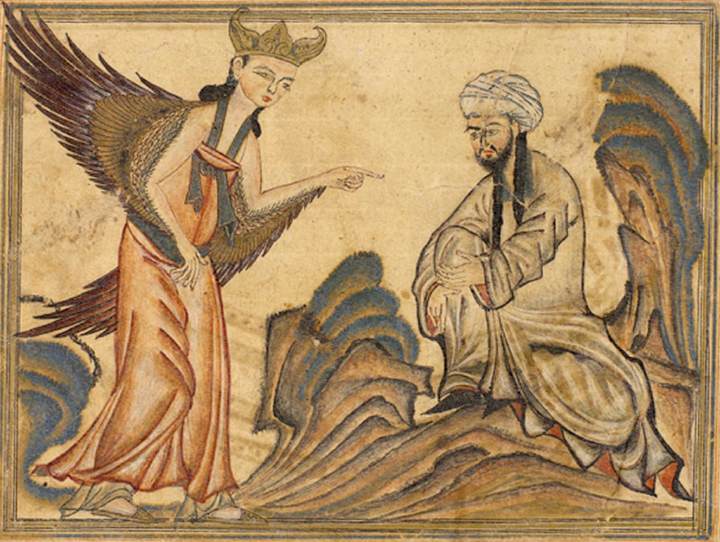
Main image: Muḥammad and the angels. Here receiving his first revelation from the angel Jibrīl. From the manuscript Jāmi’ al-Tavarīkh by Rashīd-al-Dīn Hamadānī, 1307, Ilkhanate period.